
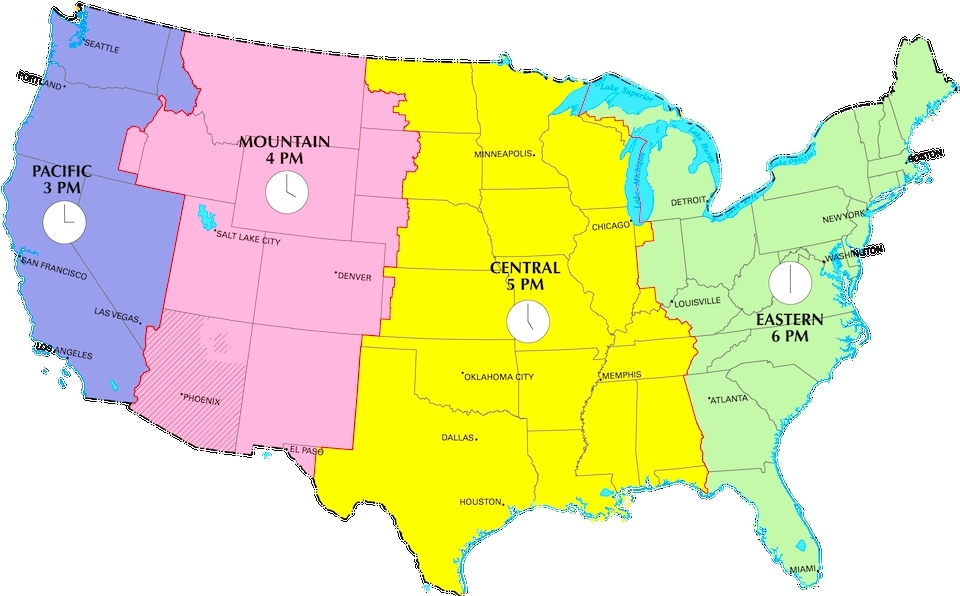
Prior to 1883 when time zones were established, there were over 144 local times in North America. If it takes a few days to get from one place to another, the resulting small time difference between neighboring cities doesn’t matter. With the advent of railways, travel in many cities became faster, and travelers were sometimes able to arrive in local time before departing. Due to the lack of standardization of timetables, the timetables of the same street were often not coordinated, causing collisions.
Standard time is determined by traffic, so state coordination of time zones is assumed by the traffic department. The federal agency responsible for regulating railroads – the Interstate Commerce Commission – was given authority to handle coordination in 1918. That year, when the United States entered World War I, five time zones were officially established: East, Central, Mountain, Pacific, and Alaska, which are still in use today. However, after World War II, the need for coordination between all modes of transport became increasingly important. When the Department of Transportation was created in 1966, it was responsible for regulating standardized time.
Daylight Saving Time (DST) is another mandate of the Department of Transportation and has since become an integral part of how modern society works. While Standard Time was introduced to improve transportation, Daylight Saving Time has become more common for reasons of economy and energy savings.
Today, the Department of Transportation continues to monitor Standard Time because of its historical and contemporary importance to transportation and related commerce. All but four regions and two states (Arizona and Hawaii) observe DST uniformly across the country. Time zone limits are also set by law and can only be changed by the Department of Transportation if the adjustment is deemed beneficial to business. In the past two decades, 15 counties (counties, cities, and counties) have changed time zone boundaries, most recently Mercer County, North Dakota. It switched from Mountain Time to Central Time in 2010. New maps in the Fall 2019 NTAD release reflect these changes and show the most up-to-date information about the country’s standard time zones.